A parasol placed in the wrong spot or poorly sized creates unnecessary shade, misaligned with the table or garden lounge. Choosing the right parasol for your terrace requires considering several often underestimated technical criteria: the fabric, the pole, the anchoring, and the sun’s path throughout the day.
Parasol Fabric and UV Protection: What the Weight Alone Doesn’t Tell You
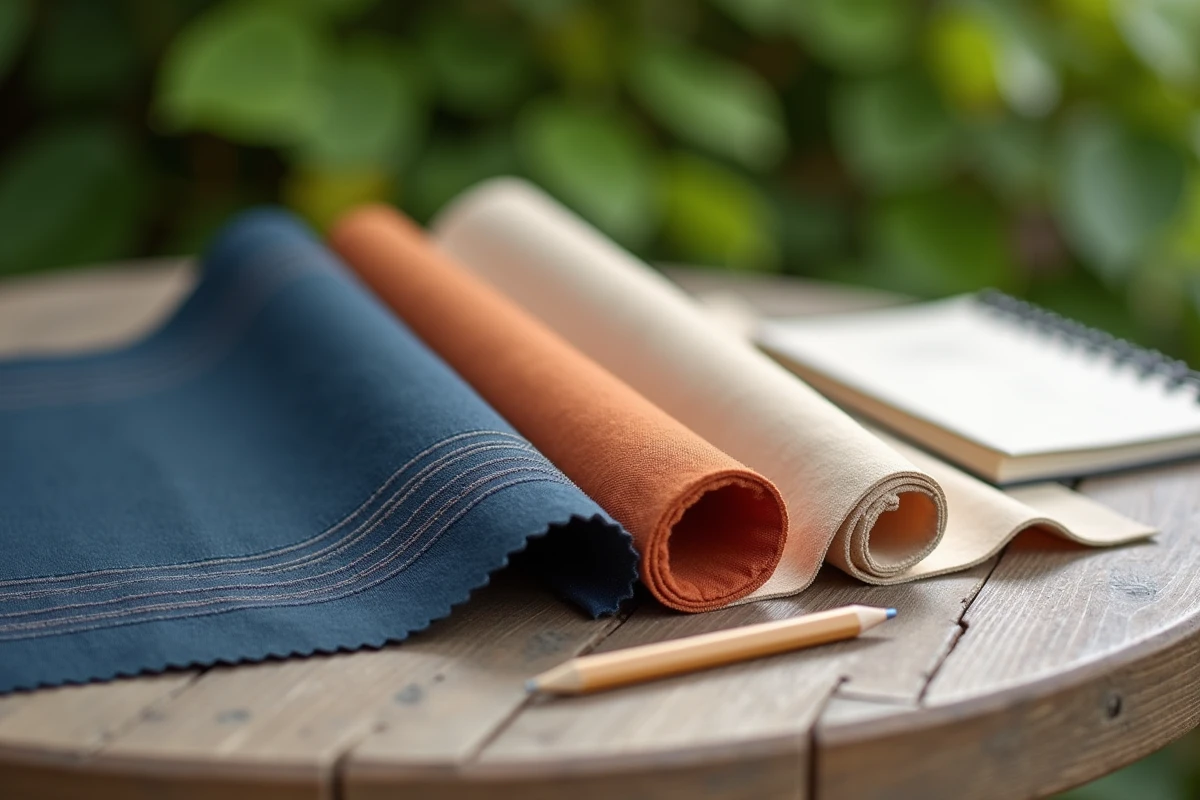
Most advice is limited to recommending a thick fabric. Weight matters, but it does not summarize a fabric’s ability to filter ultraviolet rays.
In recent years, European manufacturers of outdoor textiles have adopted the UPF (Ultraviolet Protection Factor). This labeling, based on the Australian/New Zealand standard AS/NZS 4399:2017, classifies fabrics according to their actual ability to block UV rays. A fabric labeled UPF 50+ blocks more than 98% of UV rays, according to data published by the Australian Radiation Protection and Nuclear Safety Agency (ARPANSA, updated 2023).
Have you noticed that dark fabrics seem to offer better sun protection? This is partly true: dark fabrics block more UV rays at the same weight. However, they heat up more and radiate heat under the parasol. A light fabric reflects light better and provides a cooler feeling, even if it filters slightly fewer UV rays. The choice depends on your priority: maximum protection or thermal comfort.
When purchasing, look for the UPF mention on the label or product sheet. If it is not present, at a minimum, choose a coated polyester fabric with a sufficiently dense weight, capable of withstanding several seasons. Motorized configurations, such as those offered through Profalux and Somfy motorization on Nuxo, allow you to adjust the fabric’s tilt effortlessly to follow the sun’s path.
Aluminum or Wooden Pole: A Choice That Affects Stability and Maintenance
The pole determines the rigidity, weight, and longevity of the parasol. Two materials dominate the market, each with very different uses.
Aluminum: Lightweight and Corrosion-Resistant
An aluminum pole is suitable for terraces exposed to sea spray or humidity. It is easy to handle, does not rust, and requires no annual treatment. The downside: its lightness makes it more sensitive to gusts. A weighted base suitable for the parasol’s weight is essential with an aluminum pole.
Wood: Natural Aesthetic, Regular Maintenance
Wood (teak, eucalyptus, ash) provides a warm look on a wooden or composite deck. It is heavier, which improves natural stability. However, wood requires treatment (oil or saturator) once or twice a year to prevent graying and cracking.
- Aluminum: suitable for humid areas, lightweight, no maintenance for the pole, heavy base required.
- Hardwood (teak, eucalyptus): premium aesthetic, natural stability, annual maintenance needed.
- Painted steel: robust and economical, but exposed to rust if the paint chips, best reserved for sheltered areas.
Offset Parasol on Terrace: Fixing Constraints and Ground Footprint
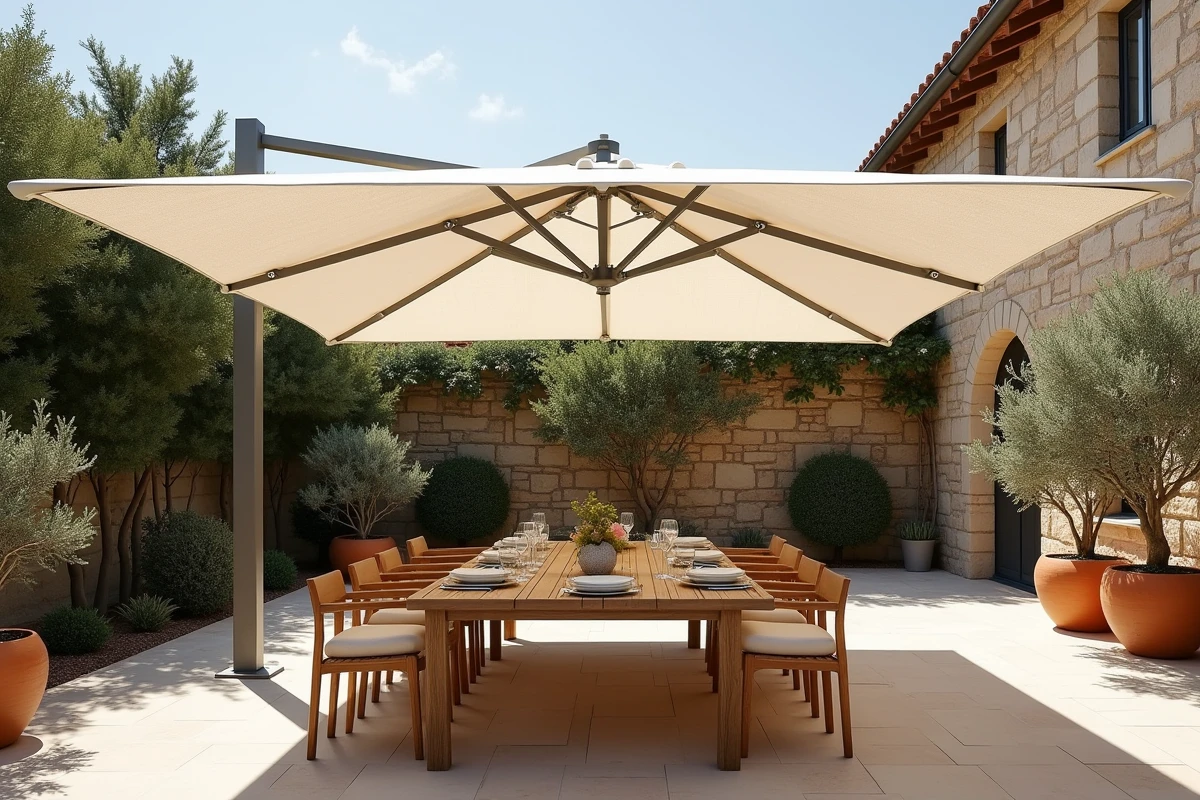
The offset parasol is appealing because it frees up space under the fabric. Its offset arm projects shade away from the base, allowing you to center the shaded area over the table without obstructing movement. But this comfort comes with a technical cost.
The base of an offset parasol is much heavier than a standard base. It must compensate for the lever effect created by the offset arm. On a raised wooden terrace, ensure that the structure can support this concentrated load. On a concrete slab, a fillable base (sand or water) or a bolted plate offers the best stability.
Another point to anticipate: the bulk of the pole and arm. A large offset parasol occupies a significant lateral volume when folded. If your terrace is adjacent to a sliding glass door, measure the remaining space when closed before ordering.
Adapting the Shape of the Parasol to the Geometry of Your Terrace
Why this choice of shape? Because the shape of the fabric directly affects the useful shaded area. A round parasol casts a circular shadow that leaves blind spots around a rectangular table. A square or rectangular parasol covers a rectangle uniformly.
- Square terrace or compact dining area: a square parasol maximizes coverage without overhanging the sides.
- Rectangular table for six or more guests: a rectangular parasol aligns its shaded area with that of the table.
- Narrow balcony or terrace along a wall: a half-parasol (wall-mounted) against the facade frees up all available depth.
- Garden lounge area without a defined shape: a round parasol remains the most versatile and easiest to orient.
Measure the area to be protected, then add about thirty centimeters on each side to compensate for the movement of the shade throughout the hours. This margin prevents the need to reposition the parasol every hour.
The parasol that enhances a terrace is not the largest or the most expensive. It is the one whose fabric effectively filters UV rays, whose pole withstands the wind, and whose shape fits the geometry of your space. Take the time to measure before choosing the model.