
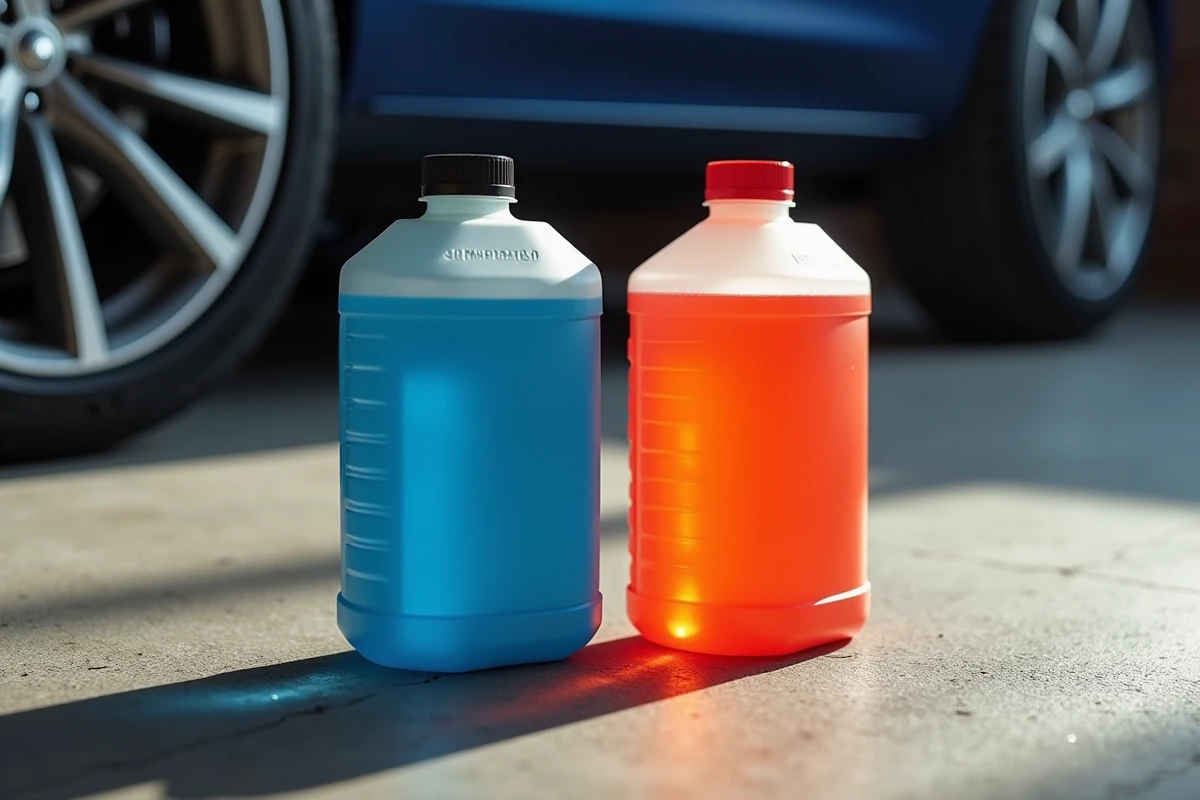
Under the hood, several reservoirs contain liquids with very different functions. Confusing coolant with windshield washer fluid can damage the engine’s cooling system or simply render the windshield wipers ineffective. The two fluids sometimes share a similar hue, complicating identification when opening the hood without a clear reference.
Texture and smell: two clues that the pictograms do not provide
The first difference is noticeable to the touch. Coolant contains ethylene glycol, a substance that leaves a slightly greasy film between the fingers. If you rub a drop between your thumb and index finger, the slippery sensation persists. Windshield washer fluid, made from alcohol and surfactants, evaporates quickly without leaving an oily residue.
The smell serves as a second reliable filter. Windshield washer fluid emits a pronounced alcoholic note, sometimes mixed with a synthetic scent. Coolant has a more neutral, slightly sweet smell. This difference is usually enough to distinguish between the two, even when both bottles share a blue or green color.
Knowing how to recognize coolant or windshield washer fluid relies as much on the senses as on reading labels, especially when a container is lying around in the garage without its original packaging.
Caps and standardized pictograms: what the hood already tells you
Manufacturers have gradually standardized the symbols on reservoir caps. Since the publication of ISO 2575:2021 on vehicle control symbols, Renault and Stellantis manuals (editions released since 2022) feature standardized pictograms.
- The coolant reservoir bears a pictogram of a thermometer immersed in a liquid, sometimes accompanied by a snowflake. Its cap is usually yellow or black.
- The windshield washer fluid reservoir displays a stylized windshield with two jets of water. Its cap is most often blue.
- The brake fluid reservoir, often located near the other two, has a circle surrounding a dot, and its cap is black or dark gray.
Despite this standardization, some older vehicles do not follow these color codes. Consulting the owner’s manual remains the safest reflex when in doubt.
Confusion between reservoirs: consequences for the engine and windshield
Pouring windshield washer fluid into the cooling system does not cause immediate damage, but it dilutes the antifreeze and anticorrosion properties of the coolant. Protection against freezing and overheating decreases rapidly, which can be problematic in cold weather or during long highway trips. The cooling system operates under pressure and at high temperature: an unsuitable fluid accelerates internal corrosion of hoses and the radiator.
The reverse error (coolant in the windshield washer reservoir) has visible effects more quickly. Ethylene glycol leaves a greasy film on the windshield, difficult to remove with the wipers. It can also damage the rubber of the wiper blades in the medium term.
In both cases, draining and rinsing the affected reservoir is sufficient to correct the problem, provided action is taken quickly.
Electric vehicles: only one reservoir accessible to the driver

On recent electric models, the issue of confusion arises differently. Tesla specifies in the Model 3 owner’s manual that the battery coolant should not be opened or topped up by the user. Only the after-sales service is authorized to intervene on this closed circuit. The same principle applies to the Renault Mégane E-Tech and the Volkswagen ID.3.
For the driver of an electric vehicle, the only container truly accessible under the hood (or under the front trunk) is that of the windshield washer fluid. This architecture simplifies routine maintenance and largely eliminates the risk of confusion between the two liquids.
However, during a workshop visit, it remains relevant to request a check of the battery cooling circuit. Replacement intervals vary by manufacturer and are not always clearly stated in the maintenance booklet.
Quick method to identify a container without a label
A bottle found in a garage without its label can be identified by combining several simple checks.
- Drop a bit on your fingers: greasy and persistent sensation for coolant, quick and clear evaporation for windshield washer fluid.
- Smell the contents: a strong alcoholic smell points to windshield washer fluid, a sweet and subtle smell points to coolant.
- Observe the viscosity: coolant flows slightly more slowly than a standard aqueous product, due to its higher density.
If doubt remains despite these tests, the most reasonable course of action is not to use the product. A bottle of windshield washer fluid or coolant is inexpensive, and the risk of contaminating a system is not worth it.
Field reports vary on the reliability of color tests alone: depending on the brands and ranges, coolant can be green, pink, orange, or blue, while windshield washer fluid is often blue or clear. Color alone is never sufficient to identify an automotive fluid.