
A piece of meat, a bite of bread, or a tablet that seems to get stuck halfway between the mouth and the stomach can trigger a understandable panic reflex. However, the appropriate response depends on a single objective criterion: can the person still breathe and talk, or not? This distinction determines whether the situation is a simple esophageal discomfort or an airway obstruction that can threaten life within minutes.
Partial or total airway obstruction: distinguishing criteria
Most articles confuse swallowing discomfort with choking. The actions to take are, however, opposite in these two cases. The table below summarizes the indicators that allow for a quick decision.
| Observed criterion | Partial obstruction (effective cough) | Total obstruction (ineffective cough) |
|---|---|---|
| Ability to speak or shout | Yes, even with difficulty | No |
| Cough | Strong, loud, productive | Silent or absent |
| Breathing | Audible, wheezing but present | Impossible or very weak |
| Facial coloration | Normal or slightly red | Cyanosis (blue lips, nails) |
| Reflex gesture | The person coughs spontaneously | The person clutches their throat |
| Action to take | Encourage coughing, do not intervene physically | Back blows followed by abdominal compressions |
The boundary between discomfort and life-threatening emergency lies in the ability to speak and breathe, not in the intensity of pain or panic felt. A person who is coughing strongly, even if panicked, still has sufficient airflow.
Knowing how to dislodge a stuck food item in the throat first requires this quick assessment, as physically intervening on a person who is still effectively coughing may move the foreign body and worsen the situation.
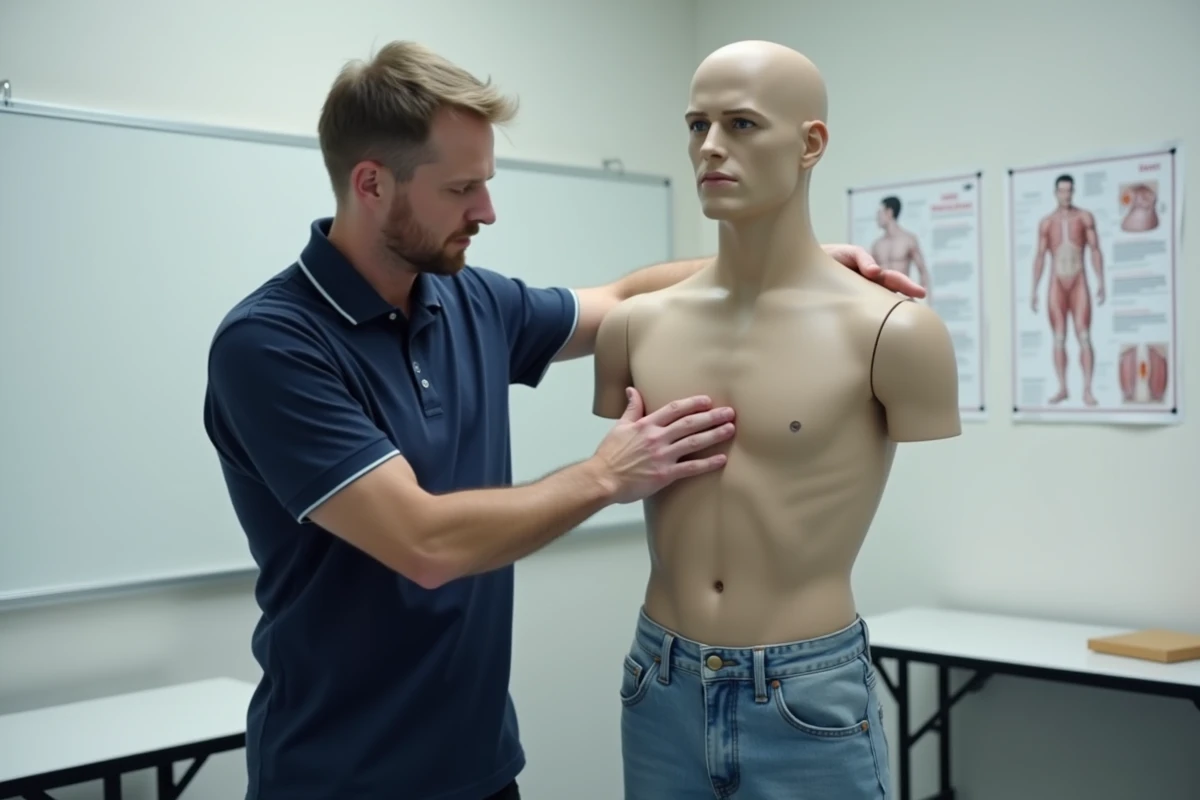
Dislodging sequence for a conscious adult: back blows and abdominal compressions
When the cough becomes ineffective (silent, the person can no longer make a sound), the recommended sequence in first aid follows a structured three-step protocol, repeated until dislodgment or loss of consciousness occurs.
- 5 back blows between the shoulder blades: lean the person forward, strike firmly with the heel of the hand between the shoulder blades, checking after each blow if the foreign body has been expelled
- 5 Heimlich-type abdominal compressions: position yourself behind the person, place your fist above the navel and below the sternum, applying sharp inward and upward pressure
- Alternate these two sets (5 blows then 5 compressions) without interruption as long as the person remains conscious and the obstruction persists
This systematic alternation is the central point of care. Many resources vaguely describe the Heimlich maneuver without specifying that it is part of a repeated cycle with back blows.
Loss of consciousness during the maneuver
If the person loses consciousness, lay them on their back on the ground. Immediately call for emergency help (15 or 112) if it has not already been done. Begin cardiopulmonary resuscitation starting with chest compressions, even if cardiac arrest is not confirmed: chest compressions can help dislodge the foreign body.
Before each rescue breath, visually check if an object is visible in the mouth. Never attempt a blind sweep with your finger, as it may push the foreign body deeper.
Effective cough and food stuck in the esophagus: why not intervene
The most common reflex when someone is coughing while eating is to give them back blows. Recent first aid recommendations emphasize a point that contradicts this reflex: if the person is coughing effectively, do not slap their back or perform abdominal compressions.
Coughing is the most powerful expulsion mechanism the body has. A loud, strong cough that still allows for air intake between bouts generates sufficient pressure to dislodge most food foreign bodies. Physically intervening risks destabilizing a food item that is still partially lodged and causing it to shift into a position of complete obstruction.
Food stuck in the esophagus without respiratory discomfort
A common and less dramatic case: the food does not block the airway but remains stuck in the esophagus. The person breathes normally, can talk, but feels pressure or pain behind the sternum. They are salivating excessively and cannot swallow.
Drinking small sips of warm water may help the food move towards the stomach. Some healthcare professionals also recommend swallowing saliva while standing, with the chin slightly lowered. However, trying to push the food with dry bread or large solid pieces is counterproductive: it may compact the blockage.
If discomfort persists beyond one to two hours, a medical consultation is necessary. An untreated esophageal foreign body can cause perforation or local edema. Emergency departments have endoscopes to remove the food under visual control.

Food aspiration: risk factors and daily prevention
Certain situations significantly increase the likelihood that food will take the wrong path or become stuck in the esophagus.
- Eating quickly without chewing enough: large, poorly chewed pieces have difficulty passing through the upper esophageal sphincter
- Talking or laughing while swallowing: the epiglottis, which closes off access to the trachea during swallowing, does not tilt properly if the person is vocalizing
- Dysphagia related to age or neurological conditions: elderly individuals and patients with diseases affecting muscle coordination (stroke, Parkinson’s) are at increased risk of aspiration
- Inappropriate texture: fibrous meats, dry or sticky foods (dense bread crust, caramel) require prolonged chewing that many people underestimate
Adapting the texture of meals, slowing the pace of eating, and avoiding talking with a full mouth remain the most effective preventive measures. For individuals suffering from chronic dysphagia, an assessment with a speech therapist specialized in swallowing can help identify postures and textures that reduce the risk of aspiration.
The criterion that guides the entire decision chain remains the same from beginning to end: free or blocked breathing. A food item stuck with preserved breathing calls for patience and possibly a consultation. An airway obstruction with ineffective coughing calls for immediate dislodgment actions, without waiting for help.