
The olive oil test in water to detect the evil eye has become one of the most shared gestures on social media in recent years. TikTok and Instagram are filled with videos presenting standardized “protocols,” often showcased as discoveries, while they actually revive village practices passed down orally in Southern Italy, Greece, or the Balkans.
Behind this virality, the ritual mechanics remain stable: concentrate the evil in a liquid medium, read a result, then dispose of it.
Ritual Logic Behind Olive Oil and Water
The principle underlying this ritual is not unique to the Mediterranean basin. In Latin America, comparable practices exist around “mal de ojo”: an egg, wax, or oil is used to extract the evil into a medium and then destroy it. Olive oil acts as a sensor. Water serves as a mirror.
This logic of “extraction and rejection” can be found in traditions that are geographically distant. What varies is the chosen medium (egg in Latin America, molten lead in the Balkans, olive oil in Italy and Greece) and the prayer or invocation that accompanies the gesture.
Some contemporary practices illustrate a marked syncretism. There are protocols that combine a prayer to Saint Benedict recited three times with the olive oil test, performed in a plate of water placed on a photo of the person concerned. The boundary between Catholic devotion, folk magic, and the diagnostic use of oil becomes very blurred.
Those who wish to remove the evil eye with olive oil often find themselves at this intersection, sometimes without being aware of it.
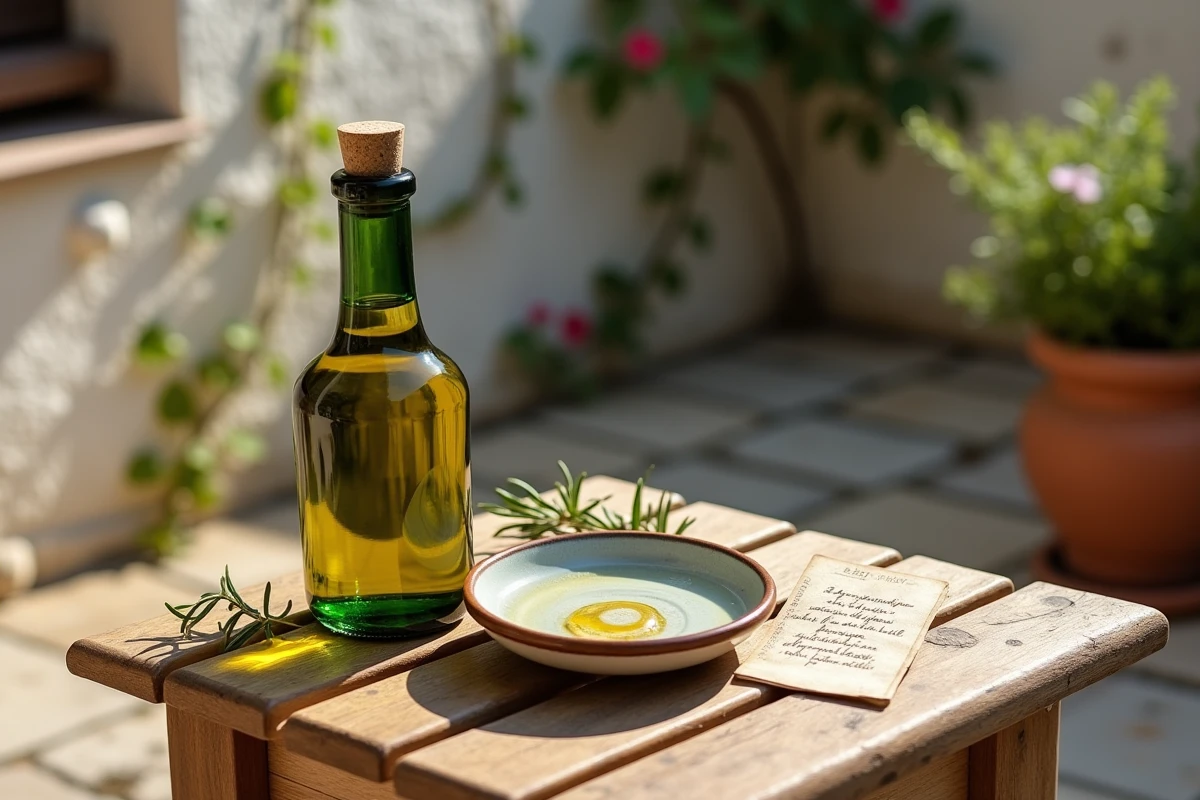
Olive Oil Test: Technical Gesture and Drop Interpretation
The ritual relies on minimal equipment: a deep plate or bowl of clear water, virgin olive oil, and an intention set before starting. Most traditions emphasize that the gesture must be performed by a third party, not by the person who believes they are affected.
Concrete Steps of the Test
- Fill a container with cold water, ideally untreated water (spring, well), although tap water is widely used in contemporary versions
- Drop three drops of olive oil onto the surface, one by one, keeping your finger or spoon a few centimeters above the water
- Observe the behavior of the drops for one to two minutes: do they remain separate and round, or do they disperse, merge, or sink to the bottom?
Traditional Interpretation
If the drops remain intact and float normally, tradition holds that there is no evil eye. Conversely, if the oil disperses, forms elongated eyes, or sinks in the water, the result is interpreted as a sign of negative influence. Some regional variants add a step: tracing a cross of oil on the left wrist of the person, repeated three times.
Field reports vary on this point: the temperature of the water, the quality of the oil, or even the height from which the drops fall can alter the physical behavior of the liquid. The surface tension of the oil in the water varies according to measurable parameters, making any interpretation strictly symbolic.
Purification After a Positive Test: Salt, Sage, and Nazar
When the test is deemed positive, several traditions propose purification gestures. Salt is the most common: it is scattered in the four corners of a room, placed in a glass of water under the bed, or thrown over the left shoulder. Burning white sage (fumigation) is another common method, borrowed from or parallel to Indigenous traditions.
The nazar boncuk, this blue glass eye ubiquitous in Turkey and Greece, functions as a preventive protective object rather than a purification tool. It is supposed to deflect the envious gaze before it settles. It is hung at the entrance of a house, on a car’s rearview mirror, or on a baby’s wrist.

Online “Anti-Evil Eye” Products: An Expanding Market
In recent years, Facebook communities and online shops have offered “ready-to-use” oils to remove the evil eye, sold as mixtures of olive oil and consecrated herbs. The accompanying instructions specify anointing points: forehead, wrists, door threshold.
This commerce transforms a free domestic gesture into a commercial product. The standardization of protocols on social media facilitates this transition: when a ritual is presented with numbered steps and a binary result (positive/negative), it resembles a pregnancy test or self-diagnosis, making it marketable.
The available data do not allow for conclusions about the actual size of this market, but the increase in sponsored posts and dedicated pages suggests sufficient demand to support a structured offer.
Olive Oil Ritual and Medical Framework
Persistent fatigue, recurring headaches, or a vague feeling of misfortune are among the signs traditionally associated with the evil eye. These symptoms also overlap with common manifestations of chronic stress, anxiety, or sleep disorders.
The ritual does not replace any medical diagnosis or psychological care. The reassuring dimension of the gesture (someone is taking care of you, naming a vague discomfort, proposing a concrete action) may partly explain the relief felt by those who resort to it.
The fact that this practice has traversed centuries and continents without disappearing speaks to the human need to ritualize uncertainty. Whether one believes in it or not, the act of pouring three drops of oil into water remains a way of reading the world, passed down quietly between generations, and now filmed in vertical format for millions of views.